Free printable · PDF · answers included
Myth or fact trivia questions, free to print
Here are 12 free myth-or-fact trivia questions with answers, ready to print for a quiz night, a holiday party or a classroom. Everyone ticks Myth or Fact, then you read the answer. Every answer is a short summary of a named source, such as NASA, NOAA or the U.S. Geological Survey.
The 12 questions
Do lemmings really commit mass suicide?
Myth or fact? Show the answer
Myth. Lemmings do not commit mass suicide. Their populations boom and crash with predators, food and climate. The famous cliff scene in Disney's 1958 film White Wilderness was staged: the lemmings were thrown off by the filmmakers. Source: Alaska Department of Fish and Game.
Do camels store water in their humps?
Myth or fact? Show the answer
Myth. Camels don't store water in their humps. The humps are made of fat, an energy reserve for when food is scarce. Camels survive the desert by conserving water in their bodies and drinking a lot when they can. Source: Natural History Museum, London.
Is a starfish a fish?
Myth or fact? Show the answer
Myth. Starfish are not fish. They're sea stars, a kind of echinoderm related to sea urchins, sand dollars and sea cucumbers. They have no backbone, fins or gills, which is why scientists prefer the name sea star. Source: NOAA National Ocean Service.
Is a killer whale actually a dolphin?
Myth or fact? Show the answer
Fact. The killer whale, or orca, is the largest member of the dolphin family, according to NOAA Fisheries. 'Killer whale' is just its old common name. Source: NOAA Fisheries.
If you touch a baby bird, will its mother reject it?
Myth or fact? Show the answer
Myth. Most birds have little or no sense of smell and cannot detect human scent on their chicks, according to Texas Parks and Wildlife. A chick put back in its nest won't be rejected for smelling of people, though it's still best to leave fledglings alone. Source: Texas Parks and Wildlife Department.
Does lightning strike the same place twice?
Myth or fact? Show the answer
Fact. Lightning often strikes the same place again and again, especially tall, pointed, isolated objects such as skyscrapers, radio towers and lone trees. Being hit once does not make a spot safe from the next storm. Source: National Weather Service (NOAA).
Is lightning hotter than the Sun?
Myth or fact? Show the answer
Fact. A lightning channel heats the air to about 50,000°F (around 27,700°C), roughly five times hotter than the visible surface of the Sun. The heat lasts only a split second, and the air's violent expansion is the thunder you hear. Source: National Weather Service (NOAA).
Do microwaves cook food from the inside out?
Myth or fact? Show the answer
Myth. Microwaves don't cook food from the inside out. They heat water molecules mainly in the outer couple of centimetres; the middle of thick food warms only as heat spreads inward, which is why leftovers can stay cold in the centre. Source: U.S. Food and Drug Administration.
Can you see the Great Wall of China from the Moon?
Myth or fact? Show the answer
Myth. You can't see the Great Wall of China from the Moon. The wall is long but narrow and similar in colour to the land around it; NASA notes that even from low Earth orbit it is hard or impossible to spot without powerful lenses. Source: NASA.
Is there a dark side of the Moon?
Myth or fact? Show the answer
Myth. There is no permanently dark side of the Moon. The far side, which we never see from Earth, gets as much sunlight as the near side; during a new moon, when our side looks dark, the far side is fully lit. Source: NASA Science.
Are bats blind?
Myth or fact? Show the answer
Myth. Bats are not blind. Their eyes are small but tuned to very low light, so many species see well in near darkness, and some fruit bats see well in daylight too. Many bats also use echolocation, so sight is one tool among several. Source: U.S. Geological Survey.
Do ostriches bury their heads in the sand?
Myth or fact? Show the answer
Myth. Ostriches don't bury their heads in the sand. They lay eggs in a shallow pit and dip their heads to check and turn them, and when threatened they may press their head and neck flat to the ground to be less visible. Source: McGill University Office for Science and Society.
How to use it
- Print page 1 for each player or team.
- Read each question aloud; everyone ticks Myth or Fact.
- Read the answers from page 2. One point per correct tick.
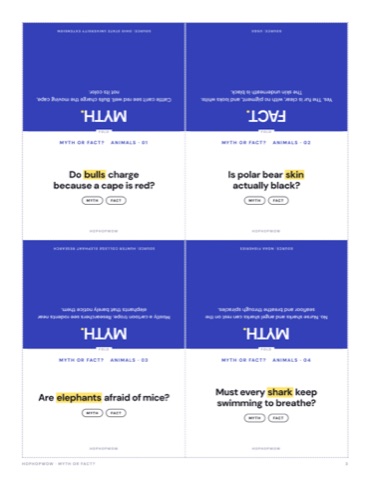
The full pack
Myth or Fact? 48 Science Cards
48 fold-up cards in six rounds, answers included. Printable PDF, instant download through Gumroad.
Get the PDF $7Questions people ask
- Where do the answers come from?
- Each answer summarises a named source, for example NASA, NOAA, the U.S. Geological Survey or the Natural History Museum in London. The source is printed under every answer.
- Is this good for a quiz night?
- Yes. Twelve questions make one round of about ten minutes. Most people get at least three wrong, which is the fun part.
- Is it suitable for kids?
- The questions are about animals, weather and space, so they work for teens and families as well as adults.
- Is there a bigger set?
- Myth or Fact? 48 Science Cards has 48 fold-up cards in six rounds, each with its source, as a printable PDF.
More free printables
- Christmas logic puzzles for adults, free to print
- A puzzle advent calendar for adults: the first 4 days free
Prefer your phone? Play the puzzles online, free.